
Behind the scenes
How Edward picks topics that actually rank
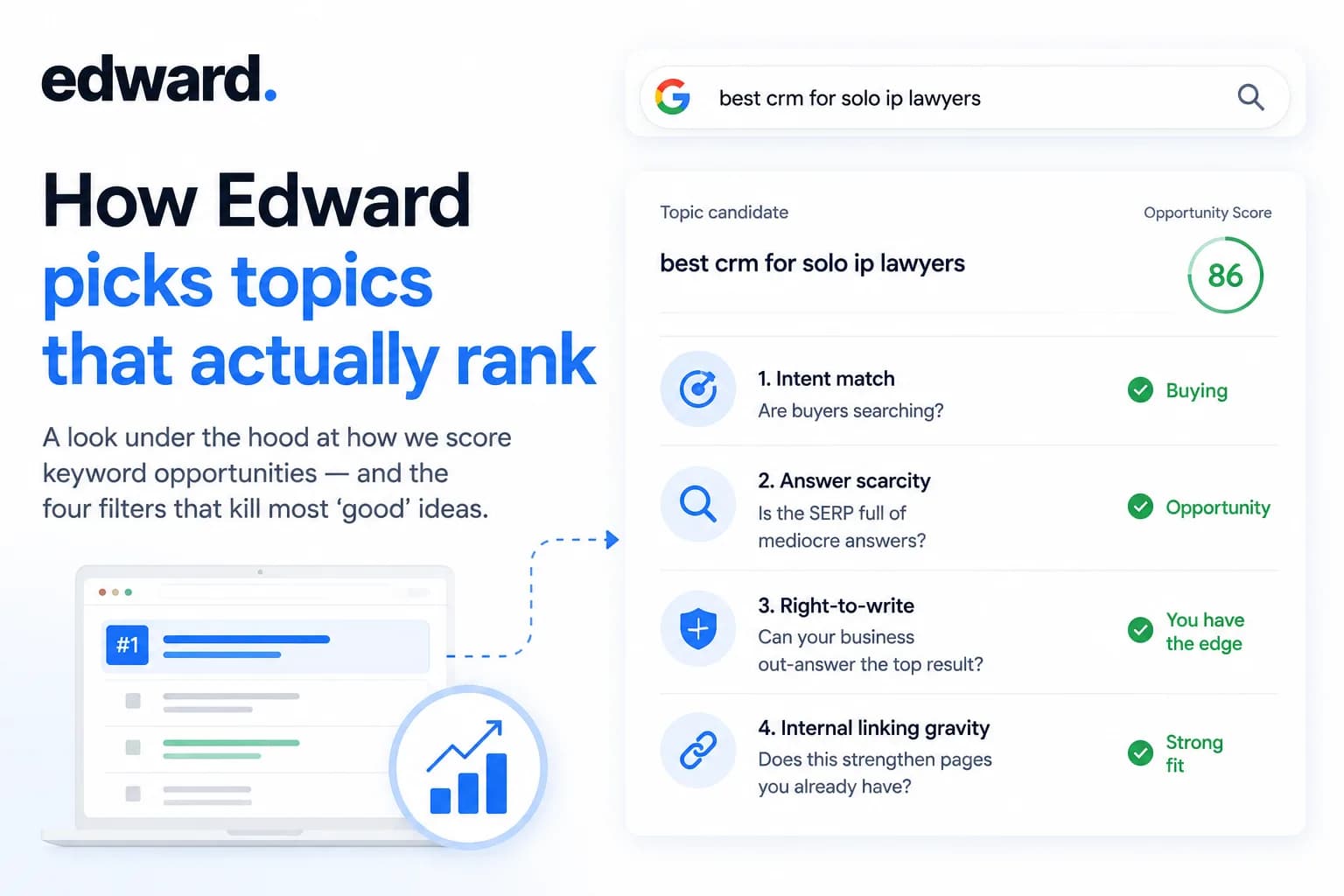
A look under the hood at how we score keyword opportunities — and the four filters that kill most 'good' ideas.

The dumb version of keyword research is "find keywords with low difficulty and high volume, then write articles about them." Every tool sold to small businesses does some variant of this. It produces a list of 200 keywords ranked by an "opportunity score" that has, in our experience, ~no correlation with whether the resulting content actually ranks.
Here's the version we run inside Edward — four filters, applied in order. Most "good" keywords die at filter two or three.
Filter 1 — Intent match: are buyers searching, or just researchers?
The first thing we do with a candidate keyword is run the SERP and look at the results page. Not the difficulty score — the page. If the top 10 results are Wikipedia, dictionary definitions, and university pages, the searcher isn't buying anything. They're a student, a journalist, or a curious 2 a.m. Wikipedia spiral.
We bucket every query into one of four intents:
- Buying — comparison pages, "best X for Y," pricing pages, product pages dominate the SERP.
- Doing — how-to pages, tutorials, step-by-step guides.
- Knowing — definitions, explainers, encyclopedia entries.
- Local — map pack appears, results are physical businesses.
For most of our customers, only Buying and Local convert. Doing converts sometimes if it leads to a tool. Knowing almost never converts — but it eats the same hours to write as a Buying page. We kill Knowing queries unless the business has a strategic reason to be the encyclopedic authority on something.
Filter 2 — Answer scarcity: is the SERP a wall of identical mediocre answers?
The opposite problem from filter 1: a keyword passes intent but the top 10 results are all the same article, written in the same voice, by the same kind of content marketer.
This is actually good — but only if you can answer the question better than everyone else. If you can't, you're entering a field where the standard is mediocre and the ceiling is mediocre. You'll rank, briefly, until the next mediocre article displaces you.
We look for two signals:
- Answer convergence: do the top results disagree, or do they all repeat the same advice from the same source?
- Answer freshness: are the top results recent, or is everyone citing a 2019 article that's been rewritten 40 times?
When everyone's reciting old advice, there's a real opening. When everyone independently agrees, the question has a settled answer — and your version won't beat theirs unless you have something none of them have.
Filter 3 — Your right-to-write: can your business credibly out-answer the top result?
This is the E-E-A-T filter, and it's where most keyword lists die. You can write anything, but you can only credibly write what your business actually does or knows.
We score this against three questions:
- Have you sold to people who'd search this? If not, the post will read like a content marketer cosplaying as an expert. Search knows the difference.
- Do you have proprietary data? Customer surveys, internal analytics, conversion benchmarks. A single original chart will out-rank ten paraphrased blog posts.
- Do you have a real opinion? Not a hedged take. Most "best X for Y" articles are useless because they don't pick. Picking is what makes a page worth linking to.
If a candidate keyword passes intent and scarcity but fails right-to-write, we either rewrite the angle (target a sub-query where the business is credible) or drop it.
Filter 4 — Internal linking gravity: does this topic strengthen pages you already have?
The last filter is the one nobody applies. A keyword that passes 1–3 is good. A keyword that passes 1–3 and gives the existing site a place to link to from three of its strongest pages is dramatically better.
This is how site authority compounds. One isolated post helps that post. A post that fits cleanly into the internal linking structure of pages already ranking helps every page in that cluster.
When we pick topics inside Edward, we cross-reference the candidate against:
- The site's top 20 pages by organic traffic.
- The pages those top-20 already link to.
- The pages that would link to the candidate if it existed.
If a candidate is internally orphan — no good link path to it, no obvious sites to receive a link from it — we deprioritize it even when everything else looks great.
A worked example
A customer of ours sells a specific type of CRM aimed at independent law firms. The naïve tool would have them writing "best CRM 2026" (high volume, low conversion, ten Forbes articles to beat). The dumb version of intent filtering gets them to "best CRM for law firms" (still 100+ articles, mostly mediocre).
What we shipped instead: a cluster of 14 pages targeting "best CRM for [specific firm size and practice area]" — solo IP lawyers, three-partner family law firms, small-firm immigration practices. Each page draws on the customer's actual book of business (they sell to all of these), each has a real opinion ranking, and each links cleanly into the customer's pillar "CRM for law firms" page.
10 of those 14 pages now rank top-5 for their query. Total organic traffic to the cluster is ~9× what the single "best CRM for law firms" page was producing, and conversion-to-trial on the cluster is 2.3× higher because the buyer landing on the specific page is closer to buying.
The pattern
We've seen this enough times now to call it a pattern: the keyword research that works for small businesses isn't about volume or difficulty — it's about specificity that the business can credibly own. The four filters are how we get there, and they're built into the topic-picking step of every plan Edward ships.
If you want to see this applied to your site, start a free audit — Edward will run your domain through the same pipeline our paying customers use.