
Playbooks
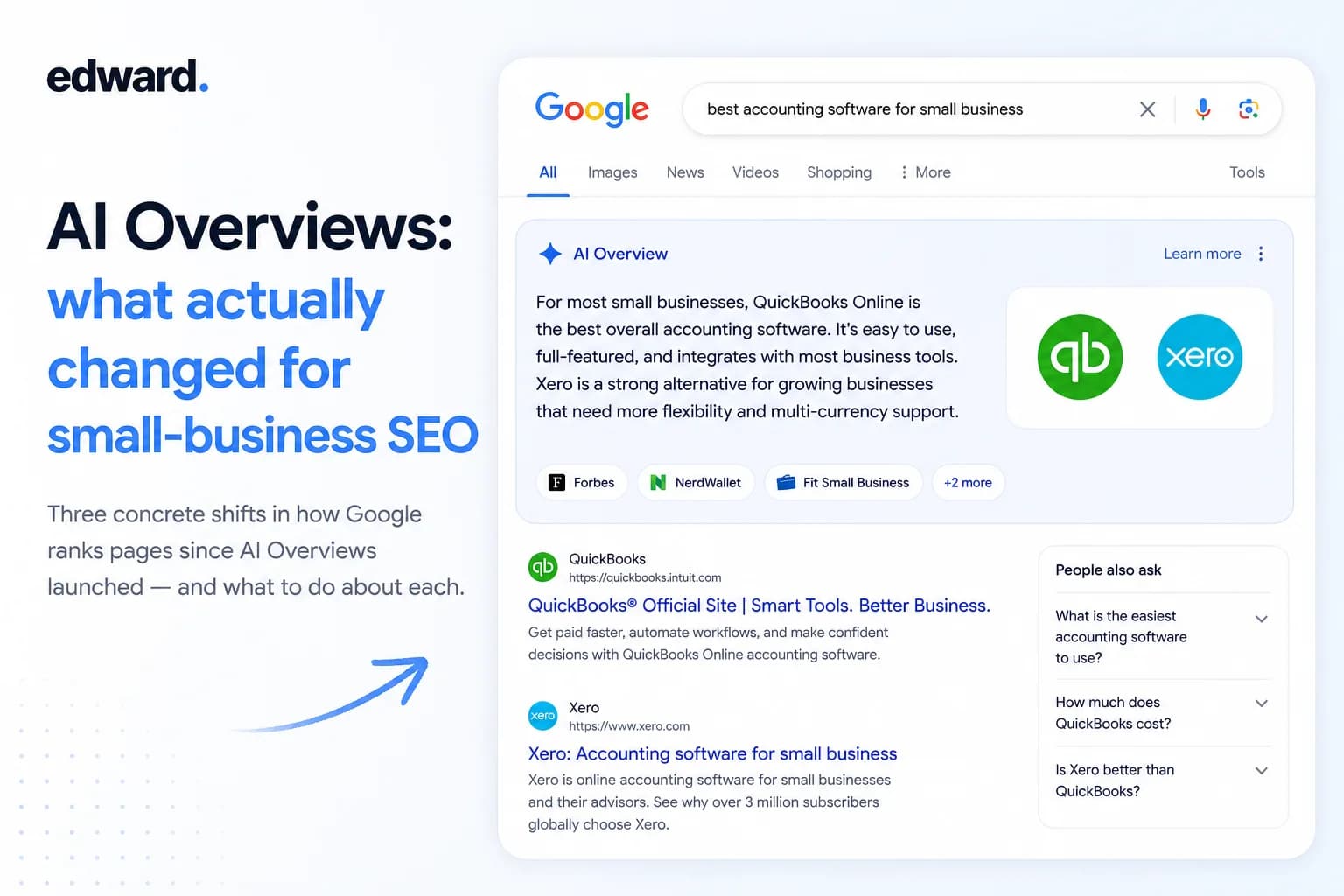
AI Overviews: what actually changed for small-business SEO
Three concrete shifts in how Google ranks pages since AI Overviews launched — and what to do about each.

A year into the AI Overviews rollout, the question we get most often from customers is the same one: "is SEO dead?" Short answer: no. Longer answer: the work changed, the leverage shifted, and a lot of the advice you're hearing online is recycled 2019 SEO with the serial numbers filed off.
Here's what we're seeing across the sites Edward publishes for — small businesses, mostly local services and DTC brands — and what we're actually shipping in response.
The shift, in one paragraph
AI Overviews replaced the top of the search results page for queries with a clean factual answer. They didn't replace the page. Below the Overview, the ten blue links are still there, often slightly demoted but still clickable. Above the Overview, ads are still ads. The interesting thing isn't that Overviews appeared — it's that they're sourcing snippets from pages that aren't always the #1 organic result. Which means the page that answers the question best now has more leverage than the page that ranks #1.
Change #1 — Queries with a clear answer collapse upward
Two years ago, "what's a good water temperature for brewing pour-over coffee" sent a user to a top-ten list, where they'd click into one or two articles. Today, they get "195–205°F" in the Overview, sourced from a single page, and they leave. That click is gone — but the Overview cites the source, and that citation is now the new top-of-page real estate.
What we ship for this:
- A
tl;drblock at the top of factual posts — usually 1–2 sentences with the literal answer to the headline question. - A question-style H2 that mirrors the search query, followed by a definitive 1-sentence answer in the first paragraph.
- Structured data where it fits —
FAQPage,HowTo, orArticlewith a clearheadlineanddescription.
What's actually getting cited isn't the page with the most words. It's the page that gives the answer in plain English, fast, without burying it under three paragraphs of "what is X" preamble.
Change #2 — "Best X for Y" pages got more powerful, not less
Counterintuitively, the queries that don't have a single clean answer — comparisons, recommendations, ranked lists — got better for SEO. Overviews tend not to fire on these (or when they do, they're noticeably hedged), and the top organic results get the click that didn't go to an Overview.
This is where small businesses can win without trying to outrank Forbes. The trick isn't writing "best CRM for startups" (you'll lose to Forbes). It's writing "best [X] for [a very specific Y you actually know about]" — the segment small enough that the big sites don't bother and specific enough that the user trusts a real practitioner more than a content farm.
What we ship for this:
- Lots of narrowly-scoped comparison pages, each targeting a specific buyer profile.
- A real opinion in the recommendation, with reasons — not a feature matrix.
- First-person experience wherever possible. "We tested this with…" beats "users report…"
Change #3 — Off-site brand mentions feed AI answers
This is the change nobody's talking about and the one that matters most over a 12-month horizon. The LLM-generated portion of an Overview blends content from the pages it cites and the broader web that the model has seen — which includes Reddit threads, podcast transcripts, news articles, and forum posts where your brand might be mentioned.
We've watched two near-identical sites, same domain authority, same on-page quality, get wildly different AI Overview visibility. The differentiator: one of them had been mentioned by name in a handful of relevant Reddit threads and a niche newsletter. That's enough.
What we ship for this:
- Outreach as a content workflow, not a backlink campaign. Comments on niche threads where the brand has real expertise to share.
- Podcast appearances, even small ones. The transcripts get indexed.
- Press in trade publications over big-name press where you'd be a footnote.
What we're doing inside Edward to ship for this
Three concrete product changes since AI Overviews launched:
- Answer-first content scoring. Every draft is scored on how quickly it answers the headline question. If the answer is buried below the fourth paragraph, we rewrite the lede.
- Query-mirroring H2s. When a page targets a question-style keyword, we auto-suggest an H2 that mirrors the exact phrasing. This pattern correlates strongly with Overview citation in our customer data.
- A weekly "mentions" report that flags new brand mentions on the open web — Reddit, forums, newsletters, podcasts — so customers can see what's compounding off-site.
What we're not doing
We're not chasing AI Overview placement as a metric. It moves, it's noisy, and Google has been honest that the system will keep shifting. We are tracking three downstream things that do compound: branded search volume, share of voice on the queries our customers care about, and the click-through rate on pages that already rank.
If the work feels different from what worked in 2022, that's because it is. The work that compounds — useful pages, plain answers, real expertise, brand presence off your own site — is the work that always compounded. AI Overviews just made the rest of the work stop paying.